Compliance & Facade Guides
Straight answers on NYC facade inspection deadlines, Local Law 11 and Local Law 126 filing requirements, commercial roof replacement and warranties, and what to do next.
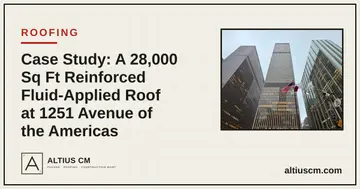
Case Study: A 28,000 Sq Ft Reinforced Fluid-Applied Roof at 1251 Avenue of the Americas
Altius CM completed a 28,000 sq ft roof at 1251 Avenue of the Americas with a reinforced fluid-applied assembly, new sheet metal, refurbished drains, painted steel, and a 2,000 sq ft concrete patching allowance.
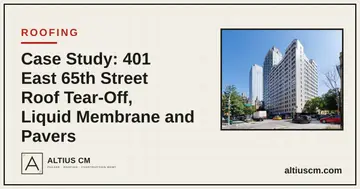
Case Study: 401 East 65th Street Roof Tear-Off, Liquid Membrane and Pavers
At 401 East 65th Street in Manhattan, Altius CM tore off a failing 6,500 sq ft roof and replaced it with a liquid-applied membrane, vacuum insulation with pitched polyiso, and Hanover porcelain pavers throughout. One hoist handled removal and delivery, with no material moving through the building interior, and the job avoided a sidewalk shed and site safety mobilization.
Flat Roof Systems Compared: TPO, PVC, EPDM, Modified Bitumen, Built-Up and Fluid-Applied
No single flat roof system wins everywhere. TPO, PVC, EPDM, modified bitumen, built-up and fluid-applied roofs each fit different roof conditions, and NYC code adds its own rules.
Roof Drains, Ponding Water and Parapet Flashing: Where Commercial Roofs Fail
NRCA defines ponding as water left over 48 hours after rain. This covers what NYC code requires for drains, scuppers and flashing, and why warranties often exclude these conditions.
Commercial Roof Insulation and the NYC Energy Conservation Code
The NYC Energy Conservation Code requires R-33 continuous insulation for commercial roofs with insulation entirely above the roof deck. When a reroof triggers that rule, the filing date decides which edition applies, and the code also sets layer, taper, and curb requirements.
Roof Replacement vs Recover vs Restoration: How to Decide for a Commercial Roof
Replace means tear-off to the deck. Recover means a new covering over the old. This lays out what NYC code allows, bars, and requires for each, plus where permit questions start.
Commercial Roof Replacement in NYC: Process, Permits and Timeline
A NYC roof replacement strips to the deck. A DOB permit is needed if the deck or sheathing is replaced (1 RCNY §101-14). The rules, clocks and sequence.
Sequencing a Roof Replacement: Access, Scaffold, Hoisting and Tenants
Pick the access and material-handling method first. It drives the shed, scaffold, hoist and tenant plan. NYC rules also set limits on sheds, hoist wind, roof storage and tenant notice.
Commercial Roof Warranties Explained: Material, System, NDL and Workmanship
A roof warranty covers named causes of leaks, not every leak. This breaks down material-only, system, workmanship and NDL, then lines up the published programs from seven manufacturers.
Facade Access Methods Compared: Swing Stage, Supported Scaffold and Rope Access in NYC
Swing stages, supported scaffolds and rope access sit under different NYC Building Code rules. A comparison of design, permit, supervision and training duties from BC 3314 and 3316.
Facade Repair Methods Explained: Repointing, Lintels, Crack Stitching, Parapets and Sealant
How the common masonry facade repairs work and when each applies: repointing, lintel and shelf angle repair, crack stitching, parapet rebuild and sealant replacement, per NPS and BIA guidance.
FISP Cycle 10 Sub-Cycles 10A, 10B and 10C: Which Filing Window Applies to Your Building
Cycle 10 sub-cycle deadlines are Feb 21, 2027 for 10A, Feb 21, 2028 for 10B, and Feb 21, 2029 for 10C, based on the last digit of your tax block. Dates checked against DOB.
From Inspection to Repair: An Owner's FISP Timeline, Step by Step
Under 1 RCNY 103-04, the main FISP clocks are 60 days to file after the final inspection, 90 days to correct Unsafe conditions, 104 days to complete repairs or seek an extension, and two weeks to file the amended report after repairs are done.
FISP Ratings Explained: What Safe, SWARMP and Unsafe Require, and By When
One Unsafe condition makes the whole facade Unsafe, with a 90-day correction clock. SWARMP carries a repair date of one to five years. Here is the rule text behind each rating.
Modified Bitumen Roofing: SBS vs APP, and Torch vs Cold vs Self-Adhered
SBS and APP are the two modifiers in mod-bit sheets. Torch, cold adhesive, self-adhered and hot asphalt are the common ways sheets are attached. Here's what manufacturers and FDNY say about each.
Local Law 126 Parking Structure Inspections: Who Files, How Often and When Each Borough Is Due
Local Law 126 of 2021 requires an engineer's inspection of NYC parking structures every six years. Filing windows run by borough, and SREM ratings trigger follow-up plus annual observation under DOB's rule.
PMMA Liquid-Applied Roofing and Waterproofing, Explained
PMMA is a two-component liquid resin reinforced with fleece that cures into a seamless membrane. This covers how it cures, where it fits, and what to ask before you specify it.
Protected Membrane (Inverted) Roofs and Paver Terraces: What Owners Should Know
A protected membrane roof puts the insulation on top of the waterproofing, usually below pavers or other ballast. Here is how the assembly goes together, what manufacturers require, and which NYC code rules apply.
DOB's FISP Recommendations Report: What's Proposed, What's Law, and What Isn't Decided Yet
DOB's Dec 2025 FISP study recommends a 6-year cycle, abbreviated filing, and more — but none of it is a rule yet. Here's the law versus the proposals.
Local Law 11 of 1998 (FISP) Explained: NYC's Facade Inspection Law for Buildings Over Six Stories
What Local Law 11 / FISP requires: covered buildings, QEWI inspections, Safe, SWARMP and Unsafe findings, filing cycles, penalties and Local Law 49.
Local Law 47 of 2025: New Sidewalk Shed Colors, 12-Foot Height, and the Proposed Netting and Design Rules
Local Law 47 changed NYC sidewalk shed colors and raised clear height to 12 feet in August 2025. DOB rules on netting and new designs are still proposed.
Local Law 49 of 2025: NYC's FISP Inspection Interval Moves to 6-12 Years
Local Law 49 of 2025 lets DOB set facade inspection intervals of 6 to 12 years from October 1, 2026, but no rule exists yet, so Cycle 10 deadlines stand.
Local Law 50 of 2025: New LED Lighting Rules for Sidewalk Sheds
Since August 15, 2025, NYC sidewalk sheds need 90 lumens-per-watt LED fixtures, brighter light and shielding near windows. What changed and what to check.
Local Law 51 of 2025: Facade Repair Milestones, Penalties, and Extensions
Local Law 51 of 2025 sets 5-month, 8-month and 2-year facade repair deadlines tied to a building's first sidewalk shed permit, with $5,000-$20,000 fines.
Local Laws 92 and 94 of 2019: NYC's Solar and Green Roof Requirements for Roof Replacements
Since November 15, 2019, a full NYC roof deck or assembly replacement needs a sustainable roofing zone: solar, green roof or both. Who's covered.
NYC's Annual Parapet Observation Requirement: Local Law 126 of 2021 and 1 RCNY §103-15
NYC buildings with a parapet fronting the street need an annual observation under Local Law 126 of 2021. Who's covered, who can observe, what to keep.
Budgeting a Facade Restoration Project in NYC: What Actually Drives the Cost
NYC facade restoration budgets run from about $200K to $3M+ on our own jobs, driven by building size, access method and conditions found once work begins.
How to Read Your Building's FISP Report: Safe, SWARMP, or Unsafe
Your FISP report classifies the facade as Safe, SWARMP or Unsafe. Here is what each finding requires you to do, and by when, under NYC DOB rules.
Local Law 48 of 2025: NYC's 90-Day Sidewalk Shed Permits and the 2026 Implementing Rule
NYC shed permits now run 90 days. A 2026 DOB rule (1 RCNY §102-07) added RDP progress reports, a $90 fee and a $2,500 penalty. Here is what changed.
NYC Sidewalk Violations: The 75-Day DOT Repair Clock, Explained
A DOT Sidewalk Violation Notice gives most NYC owners 75 days to repair defects before the City does the work and bills them. What triggers a violation.
FISP Cycle 10 Facade Inspection Guide: Sub-Cycle 10B Filing Window Is Open
NYC's FISP Cycle 10 sub-cycle 10B filing window opened Feb 21, 2026 for tax blocks ending 0, 7, or 8. Find your sub-cycle and avoid penalties.
NYC Local Law 126 Parking Structure Inspection Guide: Sub-Cycle C Filing Window Is Open
NYC's Local Law 126 requires parking structure inspections every 6 years. Sub-cycle C (Bronx, Queens, Staten Island) runs through Dec 31, 2027.